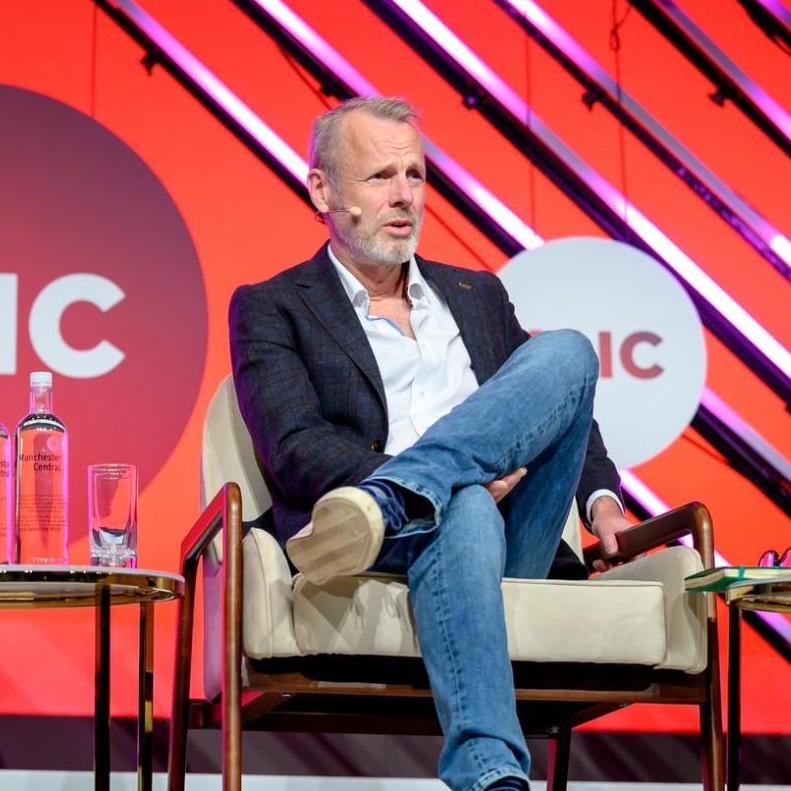
A billion journeys a year. Context is what makes that a real advertising platform.
Paul Wright Head of EMEA, Uber Advertising
Interviewed by Justin Cooke
Published

Paul Wright runs the international teams for Uber Advertising across EMEA and APAC. He joined the business in December 2022 to set up the UK and now leads the wider region. Uber Advertising started in 2020 as a sponsored-listings business inside Uber Eats for restaurant partners, and launched as Uber Advertising in 2022 to accelerate into both Eats and the Rides app. The business announced at its July 2024 earnings call that it had reached a billion-dollar run rate, hitting a target set for end of 2024 slightly ahead of schedule. Wright's career spans Sky in the late 80s and early 90s, a US start-up that raised $100m and went bust in two years, a start-up he co-founded with three colleagues that sold to Sky, an Omnicom Chief Digital Officer role, Apple's first ad business iAd, Seismic (which was sold via Chapter 11 to Amazon), Amazon, and now Uber. In this conversation he sets out the simplicity-of-data principle (Wembley plus Taylor Swift equals fan), the we don't interrupt the user experience in an irritating way rule, the 100-seconds-per-trip attention number for Journey Ads, the deliberate decision not to serve ads going to hospitals, and his career advice from David Epstein's Range: the generalist beats the specialist in an AI-driven world.
What Uber Advertising is, and the billion-dollar run rate
The path.
We started in 2020 with a straightforward sponsored-listings business built around Eats for restaurant partners. We launched Uber Advertising in 2022 to accelerate the move into advertising and also to launch into the Rides app as much as Eats. I joined in December 2022 to set up the UK and then expanded into the wider region.
We monetise the app with three core propositions. Sponsored listings inside Uber Eats, so people can see their closest stores. Advertising for CPGs (FMCGs depending on the side of the pond), getting products into baskets through convenience or restaurant partners, or running brand executions. And Journey Ads, the brand placements within the Uber Rides app experience.
In the US we have a fourth proposition, Journey TV, which is back-of-headrest screens; riders see the map and the screen becomes an engaging surface with ad opportunities.
Scale.
We announced at our July earnings call that the ads business reached a billion-dollar run rate. We set that as a target for end of 2024 and reached it slightly quicker than we'd thought. We're operational in over 30 markets as Uber Ads. Spain launched at the start of this year, and we've also expanded into other EMEA and APAC markets. Traditional sales teams in the regions, plus programmatic, performance, and display specialists.
A career through Sky, Apple iAd, Amazon, and now Uber
On the path.
I joined Sky when it first launched in the late 80s and early 90s. Sky Channel was a pan-European cable channel beaming Spider-Man repeats and the World Federation of Wrestling (now the WWE) to 300,000 homes. It evolved very quickly into pay TV. Fascinating place to learn, very entrepreneurial because the business was competitive and losing money.
I worked for a US start-up that raised $100m and went bust in two years. The flavour of those late-90s years was similar to the AI boom today: money was thrown at bets in the hope one or two would land. We did sports content advertising, started playing with online gambling, and the business went bust.
I set up a start-up with three colleagues that grew to $7m turnover in four years and sold to Sky. Another start-up with a colleague, also sold. The mid-2000s were a start-up phase. I joined Omnicom as one of their first Chief Digital Officers because they wanted someone with grey hair to navigate the increasingly complex world of digital marketing, just as Facebook was about to fly.
I went to Apple to work on iAd, Apple's first ad business. In-app advertising using key data points, with some similarity to what we now do at Uber. iAd closed in 2016 when Apple reset for Apple Search Ads. I did a start-up, then went to Seismic (an ad-serving / DSP ad-tech business) to run Europe, and was part of the management team that sold the company out of Chapter 11 to Amazon. Spent a few years at Amazon, mostly through the pandemic, then circuitously ended up at Uber in 2022.
I was made redundant three times, which is above the national average. There's an element of risk you take. Looking back, I've enjoyed it, met great people, and still have the enthusiasm for the industry. It's fun, it's full of smart people, and even when the cookie conversation feels like whack-a-mole, the innovation is real.
The simplicity-of-data principle: Wembley plus Taylor Swift
What's different about the data.
The data we have is not data a lot of other people have. If you're going to an airport, or to a concert venue, that's a data point about what you're going to do. If you're going to Wembley and Taylor Swift is playing at Wembley that night, we know you're a Taylor Swift fan. We don't need any other data point. Unless you're there for some other reason, the answer is clear. Pretty accurate data done very simply.
A lot of people have got excited about acquiring more and more data. Acquiring lots of data doesn't necessarily mean a lot. Simple data that tells you this person is going to a concert, this person is a tourist in the US is very important and relatively easy for us to derive.
The moment-of-intent argument.
The problem with a lot of digital marketing is splurge people and hope you capture them when they might be interested. With Uber, we know. 60% of people who go onto Uber Eats don't know what they're going to eat. That's like walking into a mall of restaurants. The intent is there. Whatever happened on social media before that, the decision has already been made; the brand's job is to guide the person to the right restaurant.
In Rides the moment is the same logic. A lot of the moments are cultural or social: you're going to see your friends, or you're going to a restaurant with your family. Capture the moment with a simple message, and the proposition works.
We don't interrupt, cost-per-trip, and the hospital decision
A foundational principle.
There isn't a desire inside the business to irritate the user with ads. We want ads to fit nicely within the user experience. We're not a publisher. We don't have ad clutter. Capturing people in the moment, with less ad clutter and great data, was the appeal when I joined. There are still challenges with it, but that's the structural advantage.
Why CPM doesn't work for Journey Ads.
When someone is in the Journey Ads experience, one trip is one advertiser. The brand owns the moment; it's a takeover. Cost-per-thousand doesn't prove anything in that environment because the impression metric doesn't reflect what's happening.
So we built cost-per-trip. Advertisers pay on that basis, with a set of metrics behind it. Click rate is in there as the standard, but the more interesting one is time-in-ad. The current average is around 100 seconds per ad. The average trip is 20 to 25 minutes depending on country.
Most trips have three screens. First when the ride is confirmed. Second when the driver is on the way and the map is on screen. Third when you're in the car and the map shows progress. All three carry the same advertiser, with slightly different units. Users come back to the app to check for traffic. The two-minutes-on-the-ad ends up not being a stretch.
Advertisers like it, but the metric is different from what they're used to (industry viewability has been one pixel for one second in view). Our position: you have an engaged audience looking at the ad, that's powerful. Kantar brand-lift work we've run shows increases in most key brand metrics, which we think is linked to time spent. Nothing competing for attention. You're in the moment.
A principled choice.
We could serve ads to people whose trip is taking them to a hospital. We decided that's the wrong thing to do. Where would you draw the line, and what would go with that? A more traditional publisher, where advertising is the core revenue stream, might have made a different decision. We're fortunate that ads is one revenue stream, not the only one.
Three teams, hiring for ambiguity, and the way Journey Ads got off the ground
On team structure.
Across most markets we operate as three specialist teams inside one team. One works with the restaurant partners, doing performance marketing and brand. A CPG team handles executions that range from brand to performance to offer-based partnerships with restaurants and convenience partners. A non-endemic team works with advertisers who primarily use the Rides side of the app: technology companies, auto, luxury, entertainment. The marketplace of brands we engage with is varied; we can go from a luxury-brand meeting to a QSR-restaurant meeting in the same day. Support functions sit alongside.
A specific kind of person.
Innovation in advertising is something people would like to do; with us, we do it all the time. It's in the DNA of the business. Uber in the UK launched in 2012 with Rides, just before the Olympics, then Eats, now Ads. Fast innovation. The hire for this kind of work is someone who can deal with ambiguity, who can sell formats that aren't standardised on a DSP, who can survive a meeting where the answer is we'll be the first brand to try this. We're not trying to convince a 30 or 40 year old about how Snap works; people engage with the Uber brand. Passion is the subtle thing; you can't always identify it, but the right people have it.
The practical innovation example.
When I joined I was literally one person on my own. Most of our country leads at the time started the same way. Greg in Paris, Rodrigo in Spain. The first step beyond understanding the business is finding the one or two advertisers prepared to do the innovation with you. I met with people, a lot of shoe leather. With a couple of brands it clicked because they were looking for innovation.
The principle: don't rely on a business strategy that requires everybody hits everybody and ten advertisers come on at once. Even at Sky in the early days, we never got ten advertisers in one go. Iterate: get a brand on, prove it, take the proof point to the brand's competitors, and use that. Proof points are critical. We still have greenfield brands joining us regularly and doing things we'd never expect.
The product also has to keep improving from the feedback. When we originally launched the Journey Ads product, we didn't have an add-to-wallet feature. That turned out to be critical and has been pretty successful since we added it. We had to work out how to integrate it into the platform, how the connection from trip-into-transaction works for a restaurant, a bar, a duty-free shop. The same was true for video: we knew we had to have video, and the question was how do you do video in an environment that doesn't irritate the user. Business strategy is about endurance. Be practical, find brands, get them on board, keep iterating.
Attention, commerce media, AI, and the case for the generalist
On the trends.
Three areas. The attention conversation will see a great deal more activity over the next few years; the volume of messaging being put out to consumers keeps growing exponentially and a lot of it isn't going to be effective.
First-party commerce media is fascinating. PayPal has built an ads business with Mark, a former colleague. Airlines are building ad businesses. The whole retail-media space gets more interesting.
AI: the question is how AI changes consumer behaviour, and therefore how ads work within that, rather than we have AI, so let's do stuff. Start with the customer, work back.
Beyond the trends: more competition in the marketplace is good for the industry. The big players have taken disproportionate amounts for a long time. More credible challengers across the open web makes the work better and creates room to innovate.
On the advice for the version of himself starting out.
Get a mentor early on if you can. I had a couple of mentors at Sky, although I didn't realise they were mentors at the time; they were my bosses, and they became mentors. Not everyone gets that, and it's harder these days with work schedules. Find a mentor anyway.
Take more risks. People over-assess the risk in any move. There was a stage in my career where I took a sideways move and dropped salary significantly because I needed to learn something. I told my wife it would take a couple of years and I'd be much better for the market afterwards. I was. I got headhunted out of that role.
There's a great book, Range by David Epstein, about the case for generalists in an AI-driven world. The Roger Federer comparison: Federer played multiple sports growing up. Tiger Woods just played golf. Range argues that people with broad experience adapt better to change. I've been lucky to jump from agencies to clients to start-ups and back. I wouldn't have it any other way.
The question for the board
If a billion journeys a year is the context, what share of our media spend reaches the consumer in the moment versus in front of the TV?