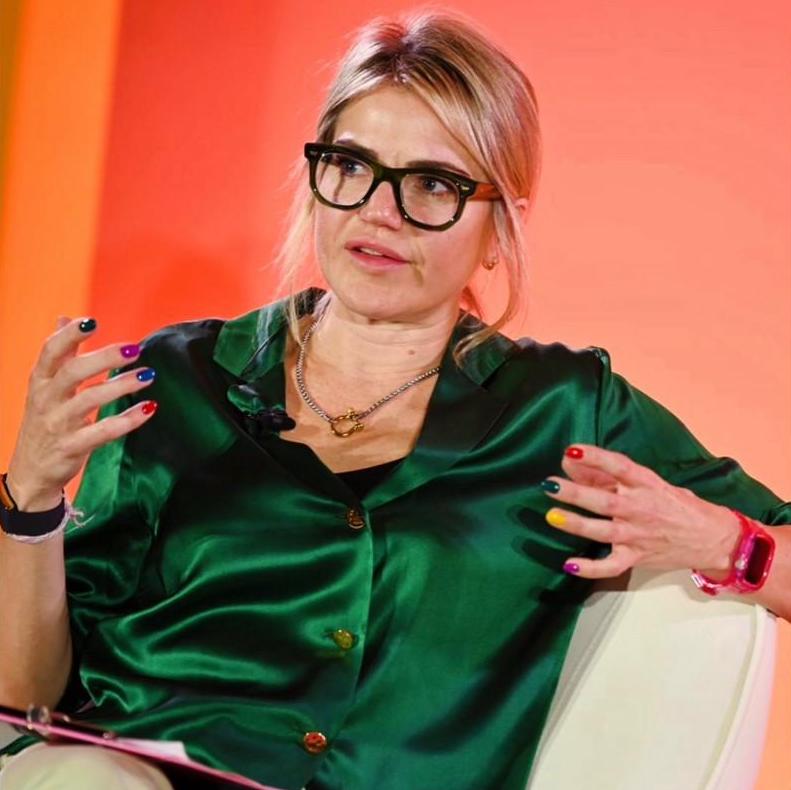
Journalism Preserves Democracy
Lotte Jones built the commercial business of The News Movement from its founding team, fusing journalism rigour with social media dynamism to reach new audiences in new ways. She came from PR and corporate communications, sold her own agency to Teneo, and brought an agency consultancy model to media, replacing traditional ad sales with brand storytelling partnerships. She is now CCO of Caliber, the holding company created from The News Movement in 2025.
“Despite looking spontaneous, there is a hell of a lot of stage management behind it. Spontaneous-looking content has a hell of a lot of stage management behind it.”
Lotte Jones was a founding team member of The News Movement, the social-first news company with newsrooms in London and New York, where she built the commercial business from scratch and led all PR, marketing, and sales. In 2025, The News Movement created a new holding company, Caliber, and Lotte became its Chief Commercial Officer. The Caliber portfolio includes The News Movement, The Recount (acquired in 2023), and the fashion newsletter Capsule.
Lotte grew up agency-side, starting in social change communications at The Forster Company and rising to Managing Director at Blue Rubicon, where she won Facebook as a client during its earliest reputational crises. In 2012 she founded Surname & Surname, a consumer-focused agency within the Blue Rubicon family, which she grew to 23 people and sold to Teneo. She then became Creative Director at Teneo Blue Rubicon, the first female CD at a PR agency. She later joined freuds as a Partner, where she created The Distillery, a team functioning as an agency within the agency.
At The News Movement, she transposed her consultancy-led agency model to the media world: brands do not buy audiences, they tell stories that enter into conversation with them. Her work with Telus Canada, Snap, and others reflects a philosophy that brand storytelling works best when it adds genuine value to the audience rather than selling at it. Her wider conviction, arrived at through three years inside a journalism operation, is that the funding crisis facing media is not a commercial problem but a democratic one, and that brand safety caution is one of its primary causes.
“Brand safety caution is starving journalism of funding. And journalism without funding cannot hold power to account.”
“We fuse the rigor and the editorial craft of journalism with the dynamism and the exciting nature of social media.”
The News Movement occupies a gap that incumbent media mastheads and native social brands both failed to fill: serious, fact-checked, editorially rigorous storytelling delivered in formats built for platforms rather than adapted to them. The journalists pitch to an editor each morning, fact-check everything, and pass a bias sniff test before anything is published. But the output looks like a creator, not a newscast. The two are not in tension. The tension is only felt when newsrooms try to adapt rather than build.
“It is about entering a conversation with young people, not selling at them.”
Lotte’s commercial model is not ad-funded. It is brand partnerships: brands that want to tell a story in a social environment, in a format that has genuine cultural value for the audience. The Telus Canada campaign did not mention network coverage. It told stories from the communities Telus supported. The metric was not reach. It was perception shift. Brand safety caution that pulls spend from journalism destroys the conditions for exactly this kind of work, and Lotte’s position is that the industry has not yet reckoned with what it costs.
“People identify more with community than global action. Our emphasis is on building communities of insight and action.”
The News Movement was founded on the premise of reaching a generation and changing how it consumed news. Three years in, the observation has shifted. Global movements feel abstract; local community feels real. The platform strategy for 2025 and beyond is built around that insight: niche communities of people who share a specific context, interest, or concern, served with journalism shaped around them rather than broadcast at them.
Stay close to the conversation.
New leaders and insights. No noise.