Service is the new sales. The pre-sales dividend changes everything.
Gareth Cummings Chief Executive Officer, eDesk
Interviewed by John Horsley
Published
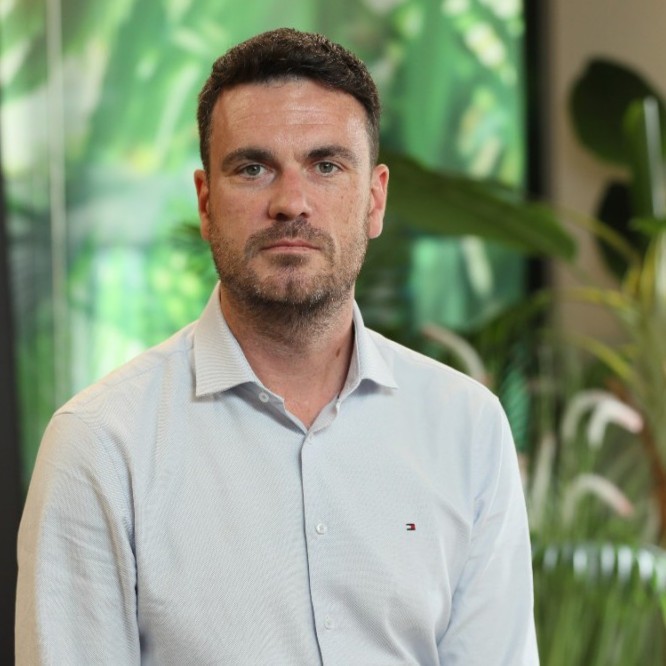
Gareth Cummings is Chief Executive Officer of eDesk, the Irish customer-support platform built specifically for e-commerce sellers. eDesk consolidates messages, queries, orders, tracking data, and product catalogues across owned websites, marketplaces (Amazon, eBay, Walmart), and social commerce (TikTok Shop, Instagram, Facebook, X) into a single inbox layered with AI automation. The company serves over 5,000 businesses, processes over 2 million conversations a month, and counts CarParts.com (named for top US customer service in 2026 by USA Today) among its customers. Cummings has been at eDesk through three roles: Chief Technology Officer, Managing Director, and now Chief Executive Officer. His earlier career runs from web development through Irish startup Globoforce (now Workhuman) and Centennial, and Brightbill (building software for North American telecoms including Comcast, T-Mobile, and AT&T). In this conversation he sets out the pre-sales questions answered within 15 minutes for a step-change in the conversion rate finding from eDesk data; the AVA AI agent built from a 2018 LLM that pre-dates ChatGPT; the trust-signal dimension of fast customer-service response; the agentic-commerce future where consumers' agents query brand agents; the iterate, RCA, no blame culture leadership philosophy; the keep her going postcard from his father in Canada; and his three-point advice for any e-commerce business not yet treating customer support as a growth engine.
A career from the Commodore 64 to e-commerce customer support
The setup.
I was always interested in computers. The first computer I had was a Commodore 64, and I'd play around with basic programming and create little games. My first proper technical job was web development. From the very first job I was in the room when customers spoke about requirements, even when I wasn't directly involved in commercial negotiations.
That continued: I joined Globoforce (now Workhuman, the Irish startup) when it was 30 or 40 people. Junior enough to be exposed to many parts of the company as it grew. Then Centennial, then Brightbill, building software for big North American telecoms (Comcast, T-Mobile, AT&T). Technical roles all the way through, with constant exposure to customers and commercials.
Transitioning from Chief Technology Officer to Managing Director to Chief Executive Officer at eDesk wasn't a leap because the commercial exposure had been built in throughout. I did a business degree for a year, dropped out because it wasn't right for me, worked in a warehouse and a bar for a while, and eventually found my way back to technology. The deeper route is no bad thing: you get exposed to different things and live more of life.
What eDesk is, and the pain points
The setup.
The easiest way to describe eDesk: have you bought something online and had an issue with it? eDesk fixes that.
We're built for online sellers and brands. They sell across their own website, marketplaces (Amazon, eBay, Walmart in the US; the broader range in the UK and Europe), and social commerce (TikTok Shop, Instagram, Facebook, X). eDesk consolidates all those channels and messages plus the orders into a single inbox. The customer-facing team can respond from one place to messages, queries, and orders. On top is the AI layer that automates the repetitive work. We focus on pre-sales queries (before purchase) and post-sales (after purchase).
On the problem.
The first pain: fragmentation. To respond to messages across Amazon Seller Central, email, and social platforms, the team has to log into each one. Not effective. It just doesn't work well at scale.
The second pain: even teams using other platforms don't have everything joined up. eDesk is unique because we were built only for e-commerce. We have the order data, the tracking information, the product information, and the product catalogue in one system. A typical e-commerce question is where's my order and when will it be delivered? eDesk can answer that from one place rather than the agent piecing it together from multiple windows.
Beyond the single view: the platform surfaces problematic areas back to the business. A product selling really well that's driving negative reviews because of delivery or product issues isn't always linked back to the rest of the business. eDesk surfaces customer sentiment about products back to the brand.
The 10 categories covering 70% of volume, and the 15-minute pre-sales window
On the e-commerce-specific dataset.
Across over 5,000 businesses and over 2 million conversations a month, around 10 categories cover roughly 70% of volume: where's my order, when will it be delivered, I need to return this, refunds, can I have an invoice. Pre-sales is a big area: what size does this come in, do you have this in stock, what's the delivery time?
The pre-sales focus is where we invested in AI early because there's a lot you can automate once the data is connected. That frees customer-facing teams to focus on higher-end problems, VIP customers, root-cause identification.
On the data.
Pre-sales accounts for about 30 to 40% of inquiries on average; for some customers up to 60%. Pre-sales gets neglected because support teams are trained for post-sale. We see pre-sales questions left unanswered.
A Harvard Business Review study a few years back showed that answering pre-sales questions within four or five hours multiplies conversion. From the eDesk data the window is much shorter: answering within 15 minutes increases the conversion chance significantly. We see it time and again. When brands come on and start using the platform and automation on pre-sales, conversions go.
We're all the same as consumers. We're home in the evening or at weekends on the phone or laptop, on impulse, on the website, with a question. If the question doesn't get answered, there's a good chance we bounce. Whether we come back is the other question.
Your website is the shop and it's open 24/7. The staff are typically Monday-to-Friday, 9-to-5. There's a big chunk of time when the shop is unstaffed. That's where AI on pre-sales becomes a 24/7 staffed shop, and the conversion lifts, and the trust signal lifts.
A practical example.
I messaged a furniture company on Instagram at 5am after engaging with their post. The piece would have fitted my purpose if extended by a few more inches. They responded within about five minutes, explained they could do a customised version, and gave me all the information I needed. I went on to read their reviews; outstanding. I'm now very likely to go through with a customisation and purchase. The fast response is a trust signal: if I have issues on this channel, I know they'll respond quickly.
That's how customer obsession becomes a flywheel: good pre-sale experience, good post-sale experience, positive reviews online, and the offline conversations with friends, colleagues, and neighbours that still matter. At NRF in New York in January the common theme from the big brands and other events: putting the customer first, building trust, the community.
Authenticity and consistency on social-commerce channels
On the social-commerce question.
Newer brands have exploded on TikTok. Hair Syrup in the UK is an example: Lucy was rejected on the BBC's Dragons' Den but has gone on to great success, growing on TikTok Shop, going on TikTok Live, engaging with the community. At the other end, big brands are trying to understand how they engage on the new channels.
The big thing on both ends is being true and authentic. People sense when a brand isn't being itself. Counterintuitively in a world of AI and agents, the brand has to come through. Authenticity matters more, rather than less.
Consistency is the other thing: being there at all times, being responsive. People often engage with a brand on one channel and buy on another. Revenue from social channels doesn't always directly correlate to direct revenue there; the consumer may engage on Instagram and come back to the website to buy.
The 2018 AI build, and AVA: the agent built from the chatbot upward
On the early AI work.
We released our first AI in 2018; we started working on it around 2017. Our advantage: we focus only on e-commerce, so the dataset is smaller and tighter (10 categories cover 70% of volume). Generic customer-support organisations face a broader, harder problem.
We had data from 2014 onwards. We built our own LLM on that smaller dataset. The computational challenge was training and retraining. We launched in September or October 2018 and it worked well.
At the time, customer expectations around AI were the opposite of today. There was a fear factor; people were reluctant to adopt even when we'd demo it working. Now the demand is there from existing customers and they're driving us toward more. Customer expectations have shot up: everyone expects us to do everything for them. The flip happened.
Because we'd built the product around AI workflows from 2018, when OpenAI and ChatGPT arrived in 2023 we could flip to those models quickly because the architecture was already there. That allowed us to move at pace, and pace is now in our DNA.
On the product.
We built AVA originally as our chatbot agent. Four or five years ago, consumers got frustrated with chatbots used as deflection techniques to keep conversations away from a human. We wanted to let a real conversation happen, plugged into the brand's data.
The data layer is the key: the agent is plugged into orders, the product catalogue, the product feed, and the content. Guardrails answer the typical pre-sales and post-sales questions, including tracking-information queries.
We extended AVA to the inbox: now the agent responds to incoming emails, Instagram comments and DMs, and marketplace messages, with the same data, the same guardrails, and the brand's tone of voice. The consistency runs across all the channels and all the mechanisms (chat, email, social, marketplace), which matters for online sellers.
On where this is going.
The natural path is your agent talking to my AI. Trust will be a key pillar. You'll give your agent parameters around the kinds of brands you engage with (review scores above X, fast responders, brands aligned with your values). For more transactional items (razor blades, commodity goods) the buy may just happen. For things you care about (something for the house, a hobby item, a piece of furniture) you'll still do the research yourself, because that's where you take pleasure.
CarParts.com, keep her going, and the iterate-RCA-no-blame philosophy
On the case.
CarParts.com was named in USA Today for top US customer service in 2026. They prioritise customer support. The CEO is involved and knows what's going on in that part of the business. Leadership focus brings focus through the organisation, which translates into using the right product (eDesk) and doing the discipline well. They didn't get the award by chance; they're successful as a business partly because they've put the customer at the centre.
I always go back to Amazon's first leadership principle: customer obsession. Put the customer at the heart of the business.
The story.
I was 24 or 25, living in Canada, going through a tough time. My father sent me a postcard. The note was keep her going, dad. It helped at the time and I've kept it with me since. People at eDesk are probably sick of me saying it because I say it. You have to keep going. Good days, bad days, weeks that don't work out, months that don't work out. Keep turning up, keep trying, keep figuring it out. Resilience is one of our culture values and a big part of it.
Jason Lemkin (SaaStr) does recurring posts on LinkedIn including even me wants to quit a couple of times a quarter. Peaks and troughs. Keep going. That delivers success in whatever field of life.
Anne Mulhauser, the Chief Executive Officer of Abercrombie & Fitch, said it differently: focus on what you can focus on. Control the controllables. That's the principle in sport too. There's so much outside noise (the world today is amplified globally on social in ways it wasn't 30 years ago) that it's overwhelming. Dial it back and focus on what you can deliver today and tomorrow. The past is the past.
On the discipline.
I try to be myself and be real. Everyone has good days and bad days regardless of title. Everyone is trying to do their best most of the time. From time to time someone isn't, but that's the exception.
A big believer in openness and iterative improvement. Blame culture leads to people not disclosing things and not improving things. I try not to blame. Trust people, believe in them, and iterate as you go along.
The discipline borrows from software development. Agile is iterative: improving time and time again. When systems break, you go through root-cause analysis: what happened, what went wrong, what can we learn, apply the fix. That principle runs through any part of the business. It doesn't mean you don't push or have high standards or want better things or be ambitious. It does mean acknowledging that the path in work and life isn't always straight; there are twists, bumps, and troughs.
2026, the three-step brief, and the advice for someone breaking in
On the focus.
We're seeing a real acceleration of AI adoption across the customer base. Our AI MRR (carved out as a separate piece even though it's part of the product) grew over 100% year-on-year. We're investing heavily because the appetite is there. We track the resolution rate: how much can AI resolve, and at what quality (CSAT, etc.).
We're also investing in surfacing analytics in a more accessible way to businesses, so they can identify what's going wrong. Because we sit on all that e-commerce data, we can pull out here's customer sentiment about this particular product, here's a top-seller that's also driving a lot of negative reviews. Surfacing that information makes it actionable.
As we move into the agentic world, more parties will be interested in our data. APIs and the platform layer of that work.
On the brief.
The first thing: if leadership and management aren't putting the customer at the heart of the business, there's going to be a challenge. Correct that.
The second: assign someone to own customer support and be responsible and accountable for it.
The third: pre-sales. Make sure pre-sales questions are getting answered, quickly and accurately, for seven days. Within 70 days you'll see an increase in conversions. The week-long experiment alone gives the data to reinforce that this is something to take seriously in the business.
On the path.
It's harder than ever right now. Studies show fewer graduate jobs. The first thing: any experience you can get stands out. If someone has interned or taken initiative during the summer to do three or four months in a company, that stands out every time.
If a young person reaches out on LinkedIn or sends me an email saying I'm really interested in getting involved, I'm trying to break through, I will always respond, and ten times out of ten I'll jump on a half-hour call. I can't always place them. I'll try to give guidance or connect them. Don't be afraid of writing the email. Don't be afraid of trying to connect with someone. Even go old-school: a letter would get my attention because someone really put effort in. Initiative and drive. Even if you don't get the placement, you often get the advice back.
Rapid-fire.
An app he couldn't live without: his Apple Watch. He liked the Whoop band for a while but woke up after a few beers being told he should be dead, so gave it up.
A book or podcast he recommends: Dale Carnegie's How to Win Friends and Influence People. An oldie but still stands up. The High Performance Podcast (Jay Comfrey). Matthew McConaughey's Greenlight came up there. McConaughey talked about obstacles and a mentality that mirrors keep her going in his own way.
Liverpool to win the Premiership or eDesk doubles revenue. If founder Ray Nolan is listening, double revenue. Money is on Liverpool to win the Champions League this year. Liverpool fans can be slightly delusional sometimes.
The question for the board
If service is the new sales, what share of our pre-sales experience earns the deal versus assumes the website does it?