Brand is a simplification tool. And the customer is the hero. Never the brand.
Paul Cash Founder and Chief Rooster, Rooster Punk
Interviewed by John Horsley
Published
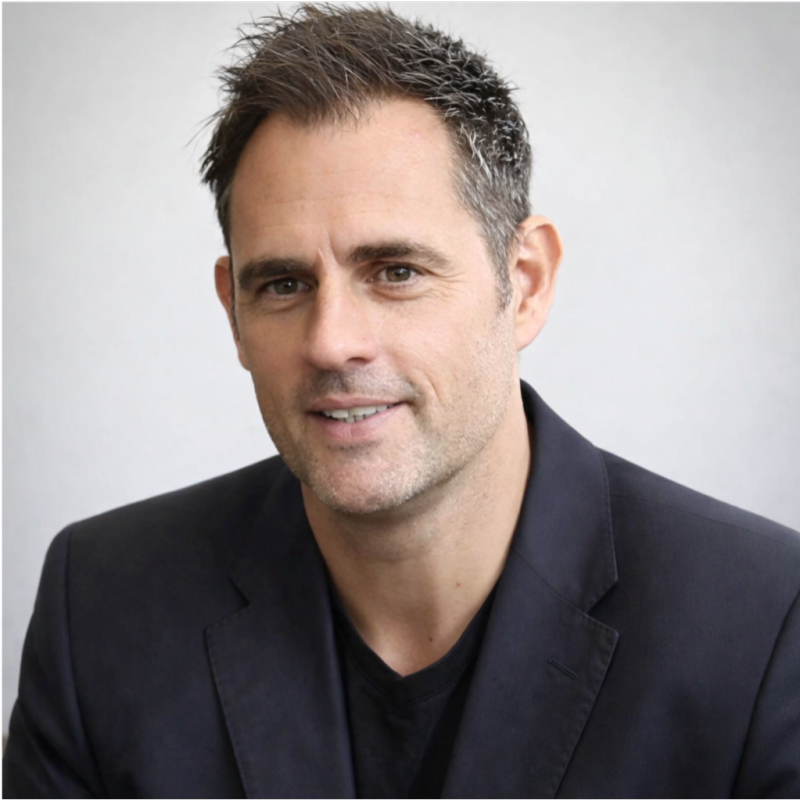
Paul Cash is Founder and Chief Rooster at Rooster Punk, the B2B storytelling agency now in its 13th year. He has founded multiple agencies across three decades, written several books on B2B storytelling, and advises CEOs of global companies on brand-led growth. In this conversation he sets out the three-yes model (emotional, trust, practical) that defines every B2B buying decision; the oxytocin rises 10 to 15% when we listen to stories biology; the brand as a simplification tool principle; and the Workday rock-stars-on-the-tour-bus turnaround from 220 million loss to 770 million profit.
A 30-year career rooted in one early meeting
The setup.
I was the kid at school who wanted to put his hand up but did not dare in case he got the answer wrong and was laughed at. First marketing job at 22 or 23 in an ad agency. First week, a big meeting with Yellow Pages. My boss turned and said Paul, can you answer that question? Fight-or-flight moment, I was scared. It came out, the room lit up, and people thought, that is a really good idea. Have you got any more?
The belief that one meeting created from that one boss gave me the sense that this was my tribe and marketing was my thing. Setting up companies, leading agencies, finding an edge as a young man. B2B became my accidental home and has been my whole career.
The internet replaced the emotion with a product catalogue
On the structural loss.
30 years ago, B2B was incredibly emotional. Pre-internet, most B2B organisations had a charismatic, empathetic, storytelling salesperson with a phone, an acetate presentation, and a trade catalogue. They built emotional connection and trust with buyers. If that person left one company for another, the clients usually went with them.
The internet came along, the expensive high-calibre salespeople went, and we did not replace the emotion and the trust. Everything went online in product format with dull, boring brand experiences. The emotional connection got lost. B2B fell into the product-marketing doom loop, performance marketing, and so on. Only now are we recognising the role of emotion to build likeable brands.
The three-yes model
On how every B2B buying decision really works.
Every client wants a customer to say yes, I would like to buy your product. Work back from the outcome: what dependencies get to that yes?
The emotional yes (delivered through brand): I like you. You are my kind of company. I understand what you do. I remember who you are when I need to.
The trust yes: I trust who you are as a business. I like the stories your customers are telling. I like your ESG strategy.
The practical yes: your product stacks up. I like your pricing model. I can understand the performance of what I get back and the economics.
Three yeses in tandem produce the eventual yes, I want to buy from you.
On the CEO conversation.
Most CEOs of large organisations are in their 50s or 60s. Their view of what brand delivered is tarnished from a world back in the 90s and 2000s. Very different today. CMOs get it for the most part, but the educational challenge of moving up the food chain has been tough. Convincing the board is a game of belief.
There is no metric on the planet that says: invest in brand day one and 30 days later you see this sales uplift. ROI is the wrong measure for brand. In the early days it is about belief. Branded search and brand-awareness uplift are usable metrics. After three or four years, you want to see actual sales growth or margin improvement. It is a question of belief, which means it is a bit fluffy, which means it is hard to sell. It requires a different type of leadership to buy into it.
Oxytocin rises 10 to 15% when we listen to stories
On the biology.
We are wired for stories. Oxytocin is a chemical present at moments of intimacy, highly present at childbirth. It creates trust and intimacy. When we listen to stories, whether via video or over a table, oxytocin in our body increases by 10 to 15 percent. That means we engage and trust people more. In B2B, trust is what we are all trying to find.
On the practice.
Story mining is finding the stories your organisation has. Story stacking is laddering them in a compelling way: customer stories, origin stories, stories about purpose, stories about moments of brilliance from a customer-service team.
A great B2B story has an emotional human truth at the heart of it. The story is about the customer is the hero, not the company. Often not told by the company. Told by a third party (customer, actor, character). Independence gives some bias. Where it is told and the format matters.
Workday: from a 220 million loss to a 770 million profit
On the worked example.
A brilliant B2B example: Workday. In 2023, Workday posted a 220 million loss. The Super Bowl campaign used Ozzy Osbourne, Billy Idol, and other rock stars. It captured human interest on a really big level. It captured the hidden buyer in the organisation.
When sales tried to get a deal over the line and the video came up, people would say I have seen that one. It created energy and trust. Activated over three years. Not the only reason, but three years later Workday went from a loss-making business to a 770 million profit. Workday's own tour bus carries rock-and-roll bands around the States. They have humanised the brand. The 95-5 dimension: when buyers are not in market, they are still making a decision about which vendors they want to use.
On the principle.
Without brand, most B2B companies are incredibly complex and difficult to understand as a buyer. Brand is a simplification tool. How do you organise everything in a company so customers easily understand who you are, what you do, and what you are about emotionally?
The CEO should be the resident chief storyteller. When we do a brand project, the laser focus is giving the CEO a new story to tell, seeing the energy in them, and watching it cascade like a waterfall through the organisation.
The question for the board
If every B2B decision needs three yeses (emotional, trust, practical), what share of marketing spend earns the first two before the third can be heard?